Staffnet+ >
New Tech Partnership Transforms Independence for Residents
New Tech Partnership Transforms Independence for Residents
“Before, I never used to go out on my own. I’m less dependent on my mum now than I was before.”
 For local resident Jade Morris, new AI-powered smart glasses have helped unlock a new level of independence and have given her the confidence to complete everyday tasks, explore her community and try things she once found difficult.
“When you’re out and about, you ask it questions like ‘what’s in front of me?’ and ‘where’s the nearest place?’ and then you’ll know exactly where you are.”
The glasses have become part of Jade’s everyday life, helping her with tasks such as recognising money, accessing information and staying connected: “I use it to recognise money. If I don’t know, I ask it what coin is in my hand and it’ll tell me. I like taking pictures, phoning and texting - you get little memos when you get a text message.”
Jade’s experience is one example of how new technology is helping residents live more independently through the Vale of Glamorgan Council’s partnership with the Innovate Trust.
The partnership between the Innovate Trust and the Adult Learning Disability Team is working to embed peoples digital needs into their digital Well-Being Assessment, to ensure that people with learning disabilities can maximize their independence.
Through using everyday devices such as AI-powered smart glasses, voice assistants and smart home technology to support people with learning disabilities and sensory impairments to overcome barriers, people are able to build confidence and have greater choice and control in their daily lives.
Rather than seeing technology as an optional extra, the partnership places digital innovation at the heart of care planning. Through personalised digital assessments, residents are matched with technology tailored to their individual needs, helping them achieve greater independence both at home and in their communities.
The partnership builds on the specialist expertise of the Innovate Trust, whose team works alongside staff within the Adult Learning Disability Team to identify practical solutions using commercially available technology.
One of the most exciting developments has been the introduction of AI-powered smart glasses, which can help people read letters, menus and signs, recognise objects and navigate unfamiliar environments.
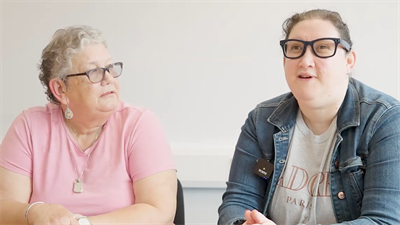 For Jade’s mum, the biggest change has been seeing her daughter’s confidence grow.
“She goes to the doctors on her own now. If she’s just going for an injection or a blood test, she’ll go on her own. She couldn’t do that before.”
She added: “It’s her confidence that’s shown me she could do a lot more than she thought she could, and I knew she could. It’s the confidence that they’ve given her to try something new.”
For Jade, the impact of the technology can be summed up simply: “They make you feel free.”
The technology is also supporting residents in different ways. Voice-activated devices such as Alexa are proving particularly beneficial for some people who are neurodivergent, providing a consistent and predictable way to interact with their environment.
Linda Woodley, Operational Manager for Adult Services, explained: “We’ve found it’s had a really positive impact for some people who are neurodivergent because it’s the same voice, it’s a consistent tone and it’s not threatening in any way.”
The Innovate Trust carries out specialist digital assessments before recommending personalised solutions and provides ongoing support to help residents make the most of the technology. Easy Read guides and trial periods also help people build confidence before deciding what technology works best for them.
The partnership is not only supporting residents – it is also helping staff develop the skills and confidence to use digital technology as part of everyday practice.
Embedding digital needs assessments into everyday practice supports the Council's wider Reshaping Programme, which is focused on changing the way we work to deliver better outcomes for residents.
Rather than considering technology as an optional extra, staff are increasingly making digital solutions a routine part of conversations about independence, ensuring people can access personalised support that meets their individual needs.
Linda said: "I think within the Learning Disability Team, staff are now embracing digital innovation. Through the support of Innovate Trust, the team have developed greater understanding of the benefits of technology and the confidence to really promote it to the people they support. Staff are witnessing firsthand the difference being digitally included can make to people’s lives. This means that when people are referred, their digital needs are considered from the outset.”
As more staff build their confidence in identifying and recommending assistive technology, digital innovation is becoming an integral part of care planning. By combining professional expertise with practical technology, the partnership is helping people achieve greater independence while creating more sustainable, person-centred services for the future.
Through the partnership with the Innovate Trust, technology is becoming another way of supporting people to achieve their goals - whether that means greater independence at home, increased confidence in the community, or simply having more choice in everyday life.