Ready to Learn Some BSL?
Did you know that around nine million people in the UK are deaf or have hearing loss?
That's almost one in five of the population. Around 640,000 people are profoundly or severely deaf, and as our population ages, these numbers are expected to continue rising.
With the recent passing of the British Sign Language (Wales) Bill, public bodies including local authorities will be required to prepare and publish plans setting out how they will promote and facilitate the use of British Sign Language (BSL).
While work is now underway to develop these plans and consider how they will be implemented, there is something we can all do right now: take time to understand what BSL is, how it is used, and how we can better support deaf and hard of hearing residents when accessing our services.
What is British Sign Language?
 British Sign Language (BSL) is the preferred language of more than 87,000 Deaf people in the UK. It is a rich, expressive language with its own grammar and structure, completely separate from spoken or written English.
BSL is a visual language that combines hand shapes and movements with facial expressions, lip patterns, body language and shoulder movements to communicate meaning.
In fact, BSL is structured differently from English. For example:
For many Deaf people, English may be a second or even third language, making access to information and services in BSL incredibly important.
One common misconception is that sign language is the same all over the world. In reality, sign languages differ from country to country, just as spoken languages do.
The UK uses British Sign Language, while other countries have their own languages, such as Irish Sign Language (ISL), American Sign Language (ASL) and Japanese Sign Language (JSL).
BSL also varies across different regions of the UK, with local variations in signs for numbers, colours and everyday words, similar to regional accents and dialects in spoken language.
Understanding fingerspelling
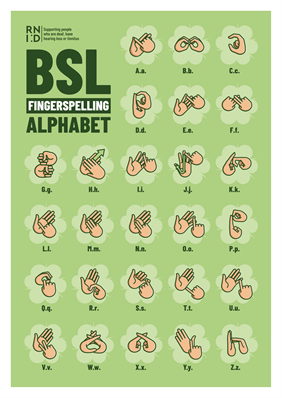
You may have seen people spelling words using their hands. This is known as fingerspelling and uses the BSL alphabet to spell out names of people, places and unfamiliar words.
While fingerspelling on its own is not sign language, it can be a useful communication tool and is often one of the first skills people learn when starting their BSL journey.
Communication is personal
There is no single way that deaf or hard of hearing people communicate.
People may use:
-
British Sign Language
-
Lipreading
-
Fingerspelling
-
Deafblind fingerspelling
-
Written communication
You can make a free custom card using the RNID personalised digital communication card tool to share your own hearing and communication preferences with others too.
 Why does this matter?
As a council, we are committed to our Vale 2030 ambitions to support and protect those who need us by making our services accessible to everyone. Understanding a little more about BSL and deaf awareness can help create a more welcoming and inclusive experience for residents, visitors and colleagues.
Sometimes, even small gestures can make a big difference. Whether that is asking someone about their preferred method of communication, learning how to introduce yourself in BSL, or using fingerspelling can help break down barriers and make people feel understood and valued.
To get started, why don't you take a look at these BSL beginner videos produced by the RNID.
Fancy learning some BSL?
The more people who can use basic BSL, the more inclusive our services and workplaces become.
Why not challenge yourself to learn a few signs or master the BSL alphabet? You could even try learning how to spell your name using fingerspelling.
If you'd like to take your learning further, ACT Training offers fully funded BSL Level 1, 2 and 3 courses for people living or working within the Cardiff Capital Region.
This includes people based in the Vale of Glamorgan, Cardiff, Bridgend, Newport, Blaenau Gwent, Caerphilly, Merthyr Tydfil, Monmouthshire, Rhondda Cynon Taf and Torfaen.
Whether you're looking to learn a few basic signs or gain a recognised qualification, developing your BSL skills can help make a real difference to the people we support every day.
Together, we can play our part in creating services that are more accessible, inclusive and welcoming for everyone.