Staffnet+ >
New AI Technology Helps Put People at the Heart of Social Services
New AI Technology Helps Put People at the Heart of Social Services
28 September 2026
Whether it's carrying out a care assessment, supporting a family through a difficult time or helping someone access the services they need, often the most valuable part of the work of our social services colleagues is the conversations they have with residents.
 But capturing those conversations accurately can mean hours of admin once a visit or assessment has ended.
That's where a new AI note-taking software is making a difference.
Social Services colleagues across the Vale are now using Notes to help reduce the time spent writing up assessments and case notes, allowing them to spend more time focusing on what matters most – supporting residents.
And the impact of the technology was recently highlighted when the Minister for AI Kanishka Narayan visited the Civic Offices to meet with social services colleagues and hear first-hand how Notes is changing the way they work.
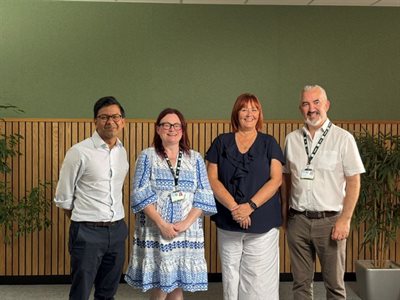
The Minister met social workers Jayne Case and Sian Palmer, alongside Jason Bennett, Head of Adult Services, to hear about their experiences of using Notes and how it is helping to reduce the administrative burden while keeping the focus on people.
Notes is created by Beam, a technology company specialising in tools designed to support frontline workers and reduce the administrative burden of casework.
Notes securely records conversations – with consent – to produce a structured draft of the meeting or assessment for the social worker to review, edit and approve.
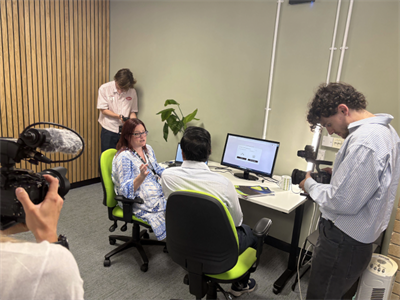 For social worker Sian Palmer, the technology has also brought an added benefit, helping her to communicate her thoughts and ideas with greater confidence.
“I feel it is important to highlight the implementation of Notes, which I have found invaluable in my role. As someone with dyslexia, I sometimes find it challenging to express my thoughts and ideas in the professional and polished way that I would like. Having access to Notes and AI support has significantly improved my confidence in communicating effectively and professionally.
“The ability to dictate case notes and record my thoughts directly into Notes, and then refine the generated output to suit my needs, has had a very positive impact on my work. It enables me to produce clear, professional documentation more efficiently, while ensuring that my intended meaning is accurately conveyed.”
The impact can be significant in terms of the time saved, too.
Jayne Case is another social worker in the Vale who focuses on arranging support for people who are leaving hospital via detailed face-to-face assessments with residents. Where an assessment that might previously have taken days to complete can now be written up and progressed within hours.
“I did an assessment at 11 o’clock yesterday and finished at half past 12. By the time I got back to my office, Notes had already typed up the assessments.
“From the time I started the assessments until the time my actual paperwork had all gone through to management for agreement took me probably about two and a half to three hours. It would usually take me about two days.”
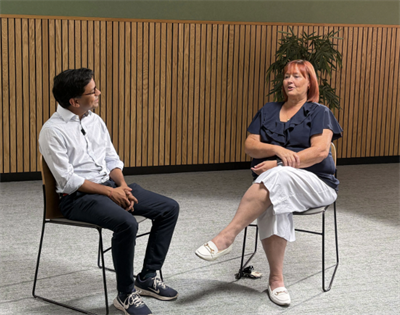 For Jayne, Notes has also changed the experience of carrying out assessments.
“I’ve got a hearing impairment, so I lip-read, and there’s nothing worse than going into a meeting and looking at the top of somebody’s head.
“So, the fact that I’m engaging with that individual has been great, and I think it builds up better relationships with that person and with their family.”
The benefits can extend beyond the assessment itself. Jayne says the time saved means she can also have greater confidence that important work is progressing when she is away from the office.
“For me, it was then being able to leave knowing the discharge plans were going ahead, rather than having to say, ‘Pass it on to somebody else to do it.’”
For managers, the time saved across the service can be equally significant.
Jason Bennett, Head of Adult Services, says the technology has been particularly valuable in supporting hospital discharge work, where timely assessments and decisions can make a significant difference.
“In terms of the actual assessments, with managers, it would previously take a day and a half. On average, if that’s hospital discharge, that’s a massive relief.”
Jason also highlighted the fact that Notes has been designed around the needs and practices of social workers, rather than simply being a generic AI tool.
“It was built for social workers. Its background is in social work. It came from social work practice, and it just feels like that.”
He says the ability to tailor the tool to the way social workers work is particularly useful, including the way assessments can reflect strengths-based practice and the voice and personal outcomes of the person being supported.
“The templates, the intuitiveness of where the note lands, the ability to embed strengths-based practice within the modules, ask it to be more strengths-based, ask it to quote the person themselves and their personal outcomes – all of that is really useful.”
Notes doesn't replace professional judgement or decision-making. Instead, it supports colleagues by reducing the administrative burden that comes with detailed case recording, meaning they can spend more time doing what matters most – supporting people.
The technology has been designed specifically with frontline teams in mind, and is already used by more than 100 local authorities across the UK.
The introduction of Notes is another great example of the Council’s Reshaping programme in action. By finding new ways to work and making better use of technology, we can give colleagues more time to focus on the conversations and relationships that matter most to the people we support across the Vale.
Notes shows how smarter ways of working can help us make the most of our time and resources, while continuing to provide high-quality support to our communities.